
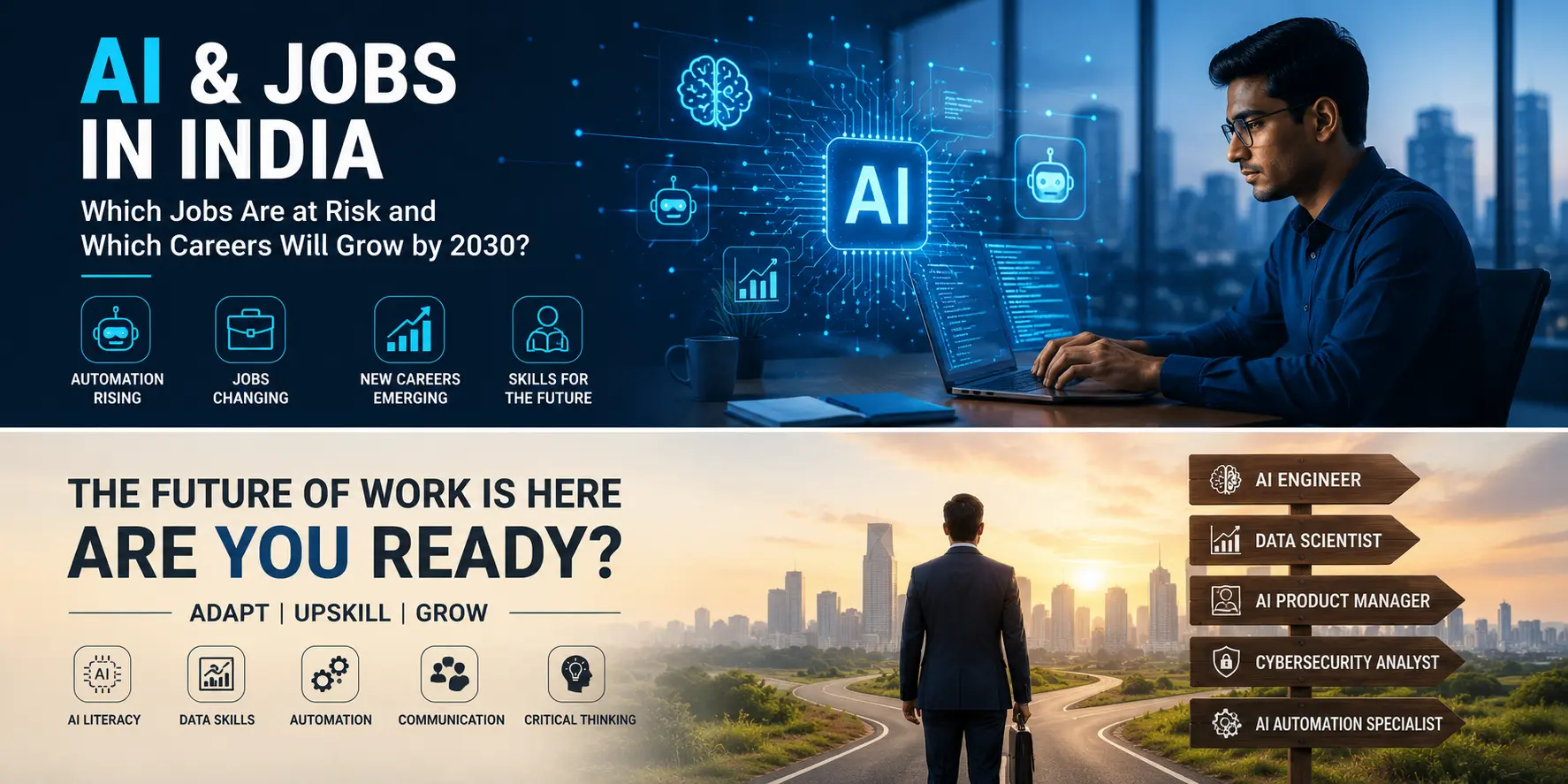
AI Is Changing India's Job Market Faster Than Many Workers Expected
Artificial intelligence has moved from being a futuristic technology to becoming a practical workplace tool. In India, AI is already being used for software development, customer support, marketing, finance, healthcare, education, data analysis and many other business functions.
The big question is no longer whether AI will affect Indian jobs. The question is which jobs will change first, which jobs could shrink, and which new careers will grow because of AI?
The answer is more complicated than simply saying “AI will take everyone's jobs.”
Recent data points to a major shift rather than a simple replacement of humans. Reuters reported in July 2026 that AI-related hiring in India's IT sector rose 16% year-on-year in June, even while overall IT recruitment declined 3%. The same report highlighted a growing demand for people with specialized AI expertise.
At the same time, the IMF estimates that around 26% of Indian workers are in occupations with high AI exposure, with some roles more likely to be complemented by AI and others more vulnerable to displacement.
That means India's workforce is entering a transition period.
The important question for students, freshers and working professionals is: Are you preparing for the jobs that are growing, or are you depending on tasks that AI can increasingly perform?
What Does AI Exposure Actually Mean?
AI exposure does not automatically mean that a job will disappear.
A job can be highly exposed to AI because some of its tasks can be automated, while the overall role may continue to exist.
For example, a digital marketer may use AI to create first drafts of content, analyze campaigns or generate ideas. But the marketer may still be responsible for strategy, understanding customers, making decisions and measuring business results.
Similarly, a software developer can use AI coding tools to write and debug code faster without the developer becoming unnecessary.
This is why the future is increasingly about human + AI collaboration, rather than simply humans versus machines.
Nasscom reported in January 2026 that AI was already performing around 20–40% of work across Indian technology organizations across functions, highlighting how quickly AI is becoming integrated into everyday work.
Which Jobs in India Are Most Exposed to AI?
The jobs most exposed to AI are generally those involving repetitive, predictable and highly digital tasks.
1. Data Entry and Basic Administrative Work
Data entry is among the most obvious areas where automation can reduce the amount of manual work required.
AI systems can extract information from documents, classify data, summarize files and move information between systems.
This does not necessarily mean every administrative employee will lose their job. Instead, companies may need fewer people for repetitive data processing while expecting employees to handle more complex coordination and decision-making.
2. Basic Customer Support
AI chatbots and voice agents are already changing customer service.
Simple questions such as order status, account information, appointment scheduling and basic troubleshooting can increasingly be handled automatically.
Human agents will still be important for complicated complaints, sensitive situations and customers who require human judgment.
3. Basic Content Writing
Generative AI can produce articles, product descriptions, social-media captions and marketing drafts within seconds.
That creates pressure on writers whose work is primarily repetitive and template-based.
However, writers who specialize in original reporting, research, storytelling, industry expertise and editorial judgment can remain valuable.
The difference is increasingly becoming content production versus content expertise.
4. Routine Graphic Design
AI image-generation and design tools are making basic visual production much faster.
Simple social posts, banners, backgrounds and advertising variations can be generated quickly.
Designers who only perform repetitive production tasks may face greater competition. Designers who understand branding, user experience, creative direction and business objectives can use AI as a productivity tool.
5. Basic Translation and Transcription
AI can now translate and transcribe large volumes of content quickly.
This may reduce demand for purely mechanical translation and transcription work.
However, legal, medical, literary and highly specialized translation still requires context, accuracy and human judgment.
Which Jobs Are Likely to Grow Because of AI?
AI does not only remove tasks. It also creates new responsibilities and entirely new job categories.
The World Economic Forum's Future of Jobs research identifies AI and machine learning specialists, big-data specialists and security-related roles among India's fastest-growing job categories toward 2030.
Here are some areas worth watching.
1. AI and Machine Learning Specialists
Companies need professionals who can build, deploy, monitor and improve AI systems.
This includes machine learning engineers, AI engineers, data scientists and related technical specialists.
Demand is likely to grow as more businesses move from experimenting with AI to integrating it into real operations.
2. AI Automation Specialists
One of the biggest opportunities may not be simply building AI models, but connecting AI with existing business processes.
Companies need people who can automate workflows involving CRM systems, email, customer service, sales, marketing and internal operations.
This is creating demand for AI automation specialists and AI workflow developers.
3. AI Product Managers
AI products require people who understand both technology and customers.
AI product managers help decide what a product should do, how AI should be used, what data is required and how the product should deliver business value.
This is a strong example of a role where human judgment remains important.
4. Cybersecurity Professionals
As companies use more AI and digital systems, cybersecurity becomes increasingly important.
AI can help attackers automate certain activities, but it can also help defenders identify threats.
This creates opportunities for cybersecurity analysts, security engineers, AI-security specialists and risk professionals.
5. Data Specialists
AI depends heavily on data.
Businesses need people who can collect, clean, analyze, govern and interpret data.
The World Economic Forum lists Big Data Specialists among the fastest-growing roles globally and in India's projected growth areas.
6. AI Trainers and AI Implementation Professionals
Many companies have access to AI tools but do not know how to use them effectively.
This creates an opportunity for professionals who can train employees, design AI workflows, create internal guidelines and help organizations adopt AI responsibly.
Will AI Replace IT Jobs in India?
This is one of the biggest questions for Indian graduates.
The answer is: some tasks will be automated, some roles will shrink, and some new roles will grow.
India's IT industry is already experiencing this transition.
Recent hiring data shows that AI-related recruitment is growing even while overall IT hiring has weakened. This suggests companies are changing the type of talent they want rather than simply abandoning technology hiring altogether.
Traditional entry-level work may face the biggest pressure.
For example, a fresher who previously spent hours performing repetitive coding, testing, documentation or data-analysis tasks may now be expected to use AI tools to complete those tasks faster.
That means the entry-level employee may need to bring more value than simply knowing how to perform a basic task.
AI Will Reward People Who Know How to Use It
One of the most important changes in the workplace could be the difference between AI users and AI builders.
A recent upGrad report highlighted by Economic Times found that 94% of surveyed learners were using AI tools, but only 20% had progressed to building AI-powered solutions such as automations, agents or applications.
This gap is important.
Knowing how to ask ChatGPT a question is useful.
Knowing how to connect AI with a company's CRM, automate lead qualification, build an AI agent or create an internal AI workflow is significantly more valuable.
The future workforce will increasingly need to move from simply using AI to working with AI strategically.
What Skills Should Indians Learn for the AI Economy?
People do not necessarily need to become AI researchers.
For most workers, the better approach is to combine their existing industry knowledge with AI skills.
AI Literacy
Understand how generative AI works, what it can do, where it fails and how to verify its output.
Prompting and AI Tool Usage
Learn how to communicate effectively with AI systems and use them for research, analysis, content, coding and productivity.
Data Skills
Basic data analysis, spreadsheets, databases and visualization can become more valuable as companies generate more information.
Automation
Learn how AI can connect with business tools and automate repetitive workflows.
Communication
Strong communication remains valuable because AI-generated information still needs human interpretation and presentation.
Critical Thinking
AI can produce convincing but incorrect information. People who can evaluate AI outputs and make sound decisions will remain important.
Industry Expertise
AI knowledge combined with expertise in finance, healthcare, marketing, law, engineering or another field can be more powerful than generic AI knowledge alone.
What About Freshers in India?
Freshers may face one of the biggest changes.
In the past, companies often hired large numbers of graduates for repetitive entry-level tasks and trained them on the job.
AI can now perform some of those tasks.
This could make the traditional “degree → entry-level job → training → promotion” pathway more competitive.
But it also creates opportunities.
A fresher who can demonstrate practical AI projects, automation workflows, data skills, coding ability and strong communication may stand out from someone whose only qualification is a degree.
The World Economic Forum says Indian employers are increasingly interested in skills-based hiring and expects companies to tap broader talent pools. It also estimates that around 63 out of every 100 Indian workers may require training by 2030.
The message for students is simple:
Don't wait until AI changes your job. Learn how AI changes your job today.
Is AI a Threat or an Opportunity for India?
It is both.
India has a huge technology workforce, a large young population and a growing digital economy.
That gives the country a significant opportunity to become a major AI talent and services hub.
India also has a challenge: workers need to be trained quickly enough to keep pace with technological change.
The government has highlighted AI as an important driver of productivity, jobs and innovation. A February 2026 PIB release said India ranked third in Stanford's 2025 Global AI Vibrancy Ranking and cited an NASSCOM AI Adoption Index figure of 87% of enterprises actively using AI solutions.
If businesses invest in AI while also investing in people, the technology could increase productivity and create new categories of work.
If companies automate without adequately reskilling workers, the transition could become much more painful.
The Biggest Career Mistake in the AI Era
The biggest mistake may not be choosing the “wrong” profession.
It may be refusing to adapt.
A marketer who learns AI can potentially become more productive.
A programmer who learns AI-assisted development can work differently.
An accountant who learns automation can reduce repetitive work.
A salesperson who learns AI-powered research can spend more time talking to customers.
A designer who understands generative AI can produce more variations while focusing on creative direction.
The winning strategy is therefore not necessarily:
“Find a job AI cannot replace.”
A better strategy is:
“Become the person who knows how to use AI to perform that job better.”
What Will the Indian Job Market Look Like by 2030?
Nobody can predict the exact job market of 2030.
However, current evidence suggests that the future will involve a mixture of automation, human work and new technology-driven roles.
The World Economic Forum estimates that globally, by 2030, technological and other macrotrends could create around 170 million jobs while displacing around 92 million, producing a net increase of approximately 78 million jobs. It also expects AI and information-processing technologies to both create and displace jobs.
For India, the opportunity is significant.
The country already has a large technology workforce, strong IT and services capabilities and a growing AI ecosystem.
But education and skills will determine how many workers benefit from the transition.
Final Verdict: AI Will Change Jobs More Than It Simply Eliminates Them
The AI revolution is already underway in India.
Some repetitive jobs will become smaller. Some existing roles will change. New AI-related careers will emerge. And many traditional professionals will increasingly work alongside AI tools.
The biggest winners may not be people who know everything about artificial intelligence.
They may be people who understand their industry + AI + problem-solving.
For students and working professionals, the smartest move is therefore to start learning now.
Don't ask only:
“Will AI take my job?”
Ask:
“How can I use AI to become more valuable in my job?”
That question could be far more important for your career by 2030.